Components That Fit Their Purpose
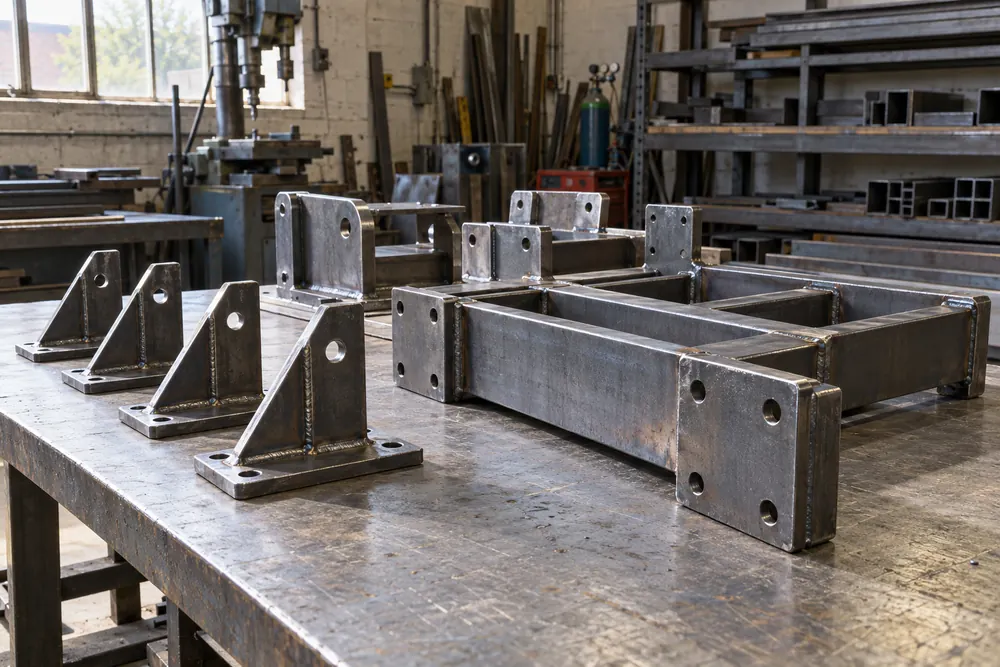
Commercial metal fabrication covers the cutting, forming and joining of metal into useful components. A job might be a series of mounting brackets for building services, a fabricated equipment frame, a protective enclosure or replacement metalwork for a production area. The right approach starts with the function of the component rather than its appearance alone.
We scope metalwork for factories, warehouses, offices, schools and managed commercial premises. Tell us what the finished item must support, protect or connect to, and whether it is a new design or a replacement. Where the component carries structural loads, the design needs suitable engineering input before manufacture.
Choosing Materials And Details
Mild steel is often appropriate for general frames and brackets, while stainless steel may suit locations where corrosion resistance or cleaning matters. Aluminium can be useful where weight is a constraint, but its stiffness, joining details and interaction with other metals still need consideration. Do not substitute a material grade without design approval.
Specify thicknesses, section sizes, hole positions and the surfaces that matter for fit. If a part is copied from an existing sample, explain how that sample has worn or changed in service. A damaged bracket should not become a manufacturing drawing without checking the intended dimensions and loading.
Workshop And Site Safety
The Provision and Use of Work Equipment Regulations 1998, known as PUWER, apply to the safe use of work equipment. When a fabricated guard becomes part of a machine, the responsible team must assess access to hazards, interlocks, maintenance and the effect of the modification. A new metal cover does not by itself establish machine safety.
Welding and cutting also require controls for fumes, heat and flying particles. The HSE welding guidance explains the need to control fume under COSHH. Work within an occupied commercial site needs coordination with its permit system and the people responsible for surrounding activities.
If a fabrication is a structural construction product, assess the relevant BS EN 1090 requirements separately. Decorative or general workshop metalwork should not automatically be described as a structural package. Agree the intended use and the documents required before selecting a supplier.
From Enquiry To Finished Assembly
Start with a dimensioned drawing, sketch or photographs showing the location and purpose. State the quantity and whether the item needs to fit existing equipment. We clarify critical dimensions, tolerances and any design decisions that remain open.
The fabrication route can then be planned around cutting, drilling, forming and joining. Agree whether an initial sample or trial assembly is needed before a batch is released. Repeated parts benefit from a consistent drawing reference and a clear method for checking the features that control fit.
After fabrication, the edges, welds and finish are checked against the agreed acceptance criteria. The delivery plan should protect finished surfaces and identify heavier or awkward items that need mechanical handling. Site fixing and final adjustment need a defined scope rather than an assumption that everything is included.
Finishes And Service Conditions
Paint, powder coating and galvanising serve different needs and should be chosen around exposure, appearance and maintenance. Hollow sections may require venting and drainage details for galvanising, to be agreed with the finishing specialist. Coating can also change how close-fitting components assemble.
Consider wet cleaning, chemical contact, outdoor exposure and dissimilar metal contact when specifying the finish. Surfaces that will be welded or adjusted on site need an agreed treatment afterwards. Ask for coating information and practical maintenance instructions where the finish contributes to the expected service life.
What A Fabrication Quote Needs
The main cost drivers are material, quantity, complexity, set-up time, tolerances and finishing. One-off parts require preparation even when they are small, while repeated components may share tooling and setting time. Tight tolerances should be reserved for dimensions that genuinely control performance.
Include packing, delivery, installation and any access limitations in the enquiry. If the design is still evolving, request a quotation with clearly stated assumptions. For thin folded panels, use our sheet metal fabrication page, and for a unique assembly see bespoke steel fabrication.
Metal Fabrication Questions
Can Metal Fabrication Be Made From A Sketch?
Metal fabrication can start from a sketch when it explains the intended use and the main dimensions. Critical features, material and fixing details still need to be agreed before manufacture. Include photographs of the location, and identify any loadbearing role so that necessary design checks are completed rather than inferred from the sketch.
Which Metal Is Best For Commercial Fabrication?
The best metal for commercial fabrication depends on loading, exposure, cleaning, weight and the way the part will be joined. Mild steel, stainless steel and aluminium have different properties and finishing needs. Describe the operating conditions first, then agree the grade and finish with the responsible designer and fabricator before ordering material.